Local Loop: Modeling Neighborhood Vitality Through Human Behavior
Project Overview
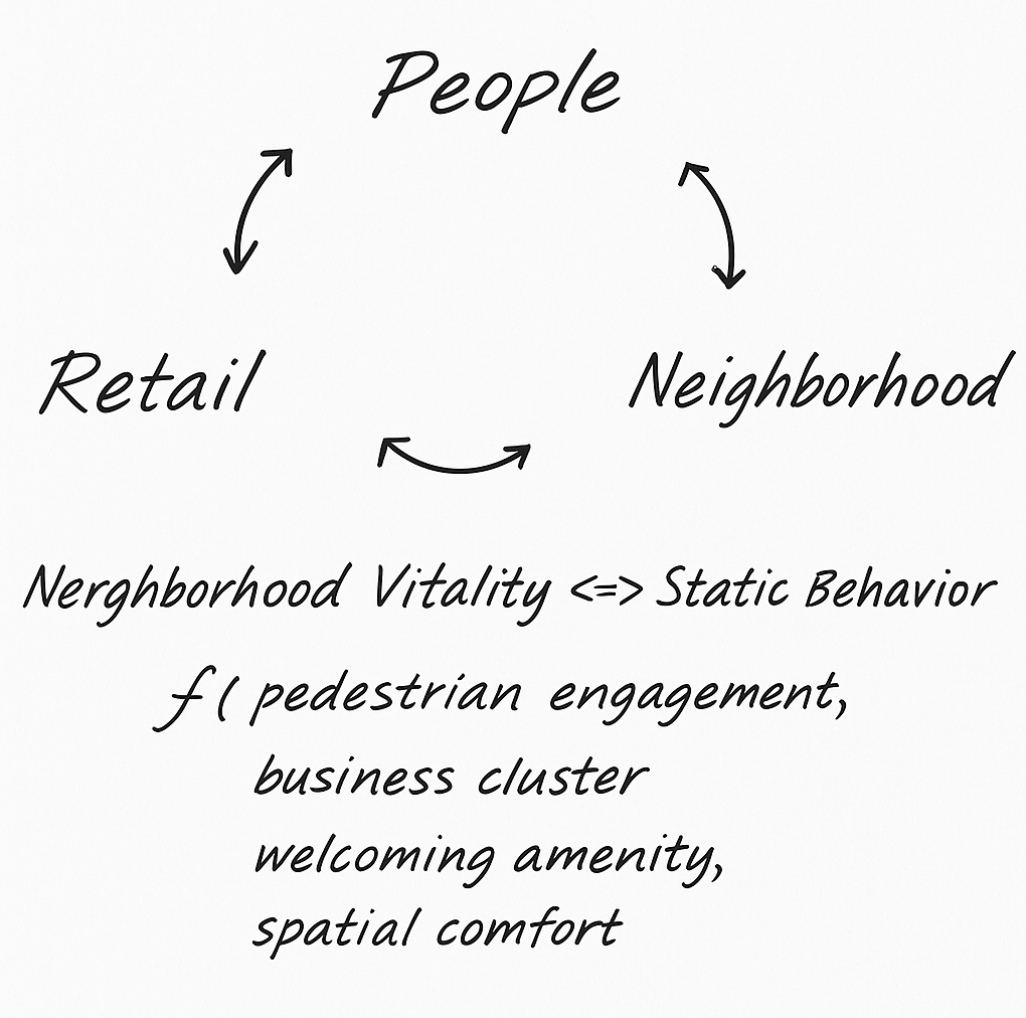
Local Loop examines how people use streets at the neighborhood scale, with a focus on stationary activities such as pausing, lingering, browsing, and interacting. Rather than relying only on movement-based metrics like pedestrian counts, this project explores how these “staying” behaviors reflect people’s comfort, engagement, and use of public space.
The project studies how retail environments and nearby spatial conditions influence staying behavior. Observational and qualitative findings are used to identify behavioral and environmental factors that could later be translated into variables for neighborhood-scale analysis and modeling.
Research Question
How do retail stores and their surrounding environmental conditions influence pedestrian staying behavior and contribute to neighborhood vitality?
Hypotheis
Pedestrian engagement, business clustering, spatial comfort, and environmental cues significantly increase stationary human behavior, such as pausing, standing, lingering, waiting, browsing, interacting
Research Context
“Staying” Activity as Indicator for Urban Vitality
This project treats stationary behavior as an observable indicator of how people experience streets and neighborhood environments
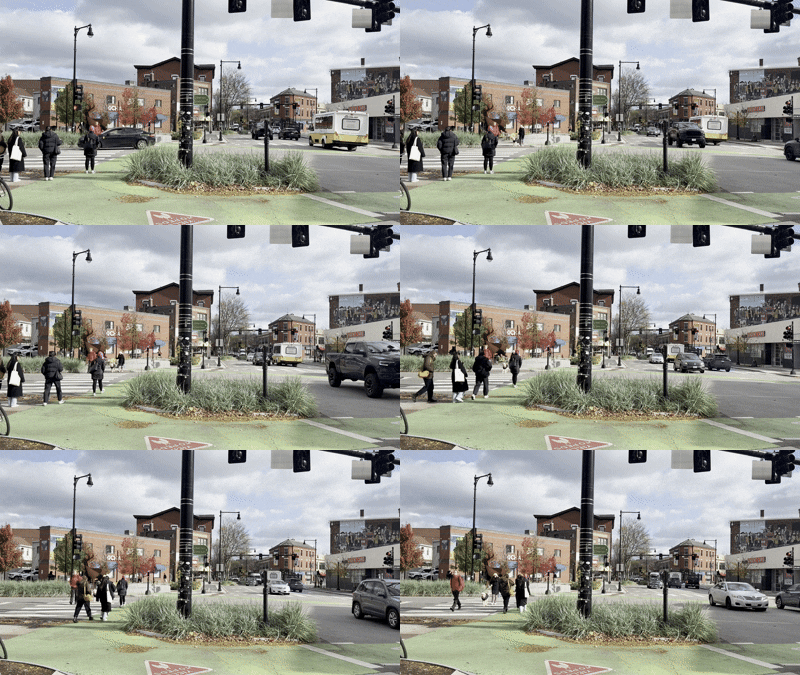
Measures of urban activity often emphasize movement: pedestrians passing storefronts, cyclists gliding along bike lanes, and vehicles flowing through intersections
While useful, movements do not capture whether people feel comfortable stopping, spending time, or interacting in public space. It is the more “staying” activities—pausing, lingering, browsing, talking, and gathering—that reveal deeper qualities of a place
These behaviors make belonging visible in public space, signaling comfort, safety, and emotional ease; they show that people feel welcome enough to slow down, occupy space, and engage with their surroundings
Small retail businesses are an important part of this environment. They often provide reasons for people to slow down, stop, and engage with their surroundings, shaping everyday street life at a local scale
Staying behavior captures the lived, relational dimension of urban vitality — something movement counts alone can never measure.
Research Methods
Study Areas
Cambridge, MA and Somerville, MA
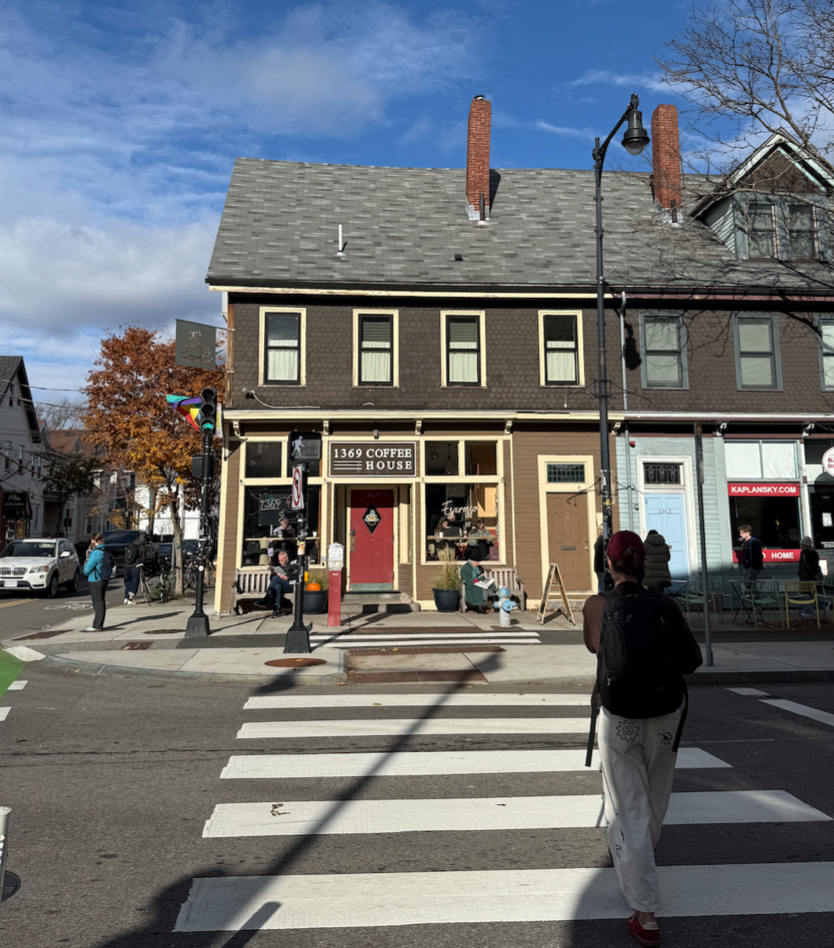
(Inman Square, Central Square, and Union Square / Bow Market)
Methods
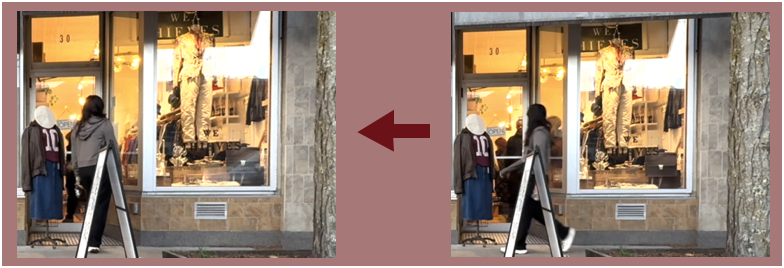
Street-level observation of pedestrian behavior
Short surveys with pedestrians
Interviews with local residents and small business owners
These methods were used to document staying behavior, pedestrian engagement with storefronts, and environmental conditions that appeared to support or discourage longer stays
Pedestrian Behavior Categories
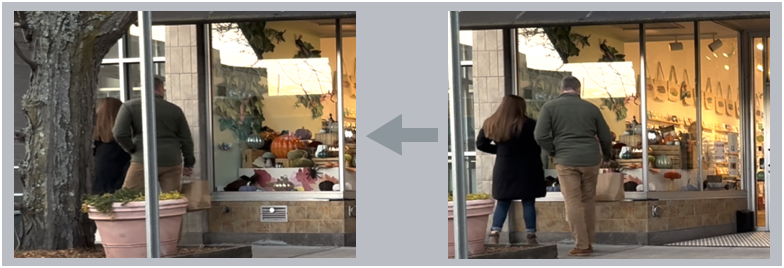
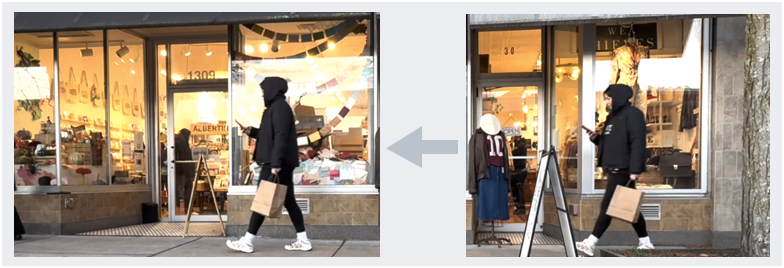
These categories reflect different levels of attention and interaction with the street environment. They were used as an analytical tool to compare how different pedestrians respond to retail and spatial condition
Observations on Staying Behavior
Staying behavior varied systematically across sites and was shaped by both individual intent and spatial context:
Trip purpose: intentional visitors stayed longer than spontaneous browsers, showing that purpose-driven trips meaningfully increase stationary activity
Group presence: groups tended to linger longer indoors but moved more quickly outdoors, suggesting that collective decision-making accelerates movement unless there is a strong incentive to pause
Store characteristics: stores with broader product ranges or a clear identity supported longer engagement, demonstrating how scale, diversity, and legibility shape dwell time
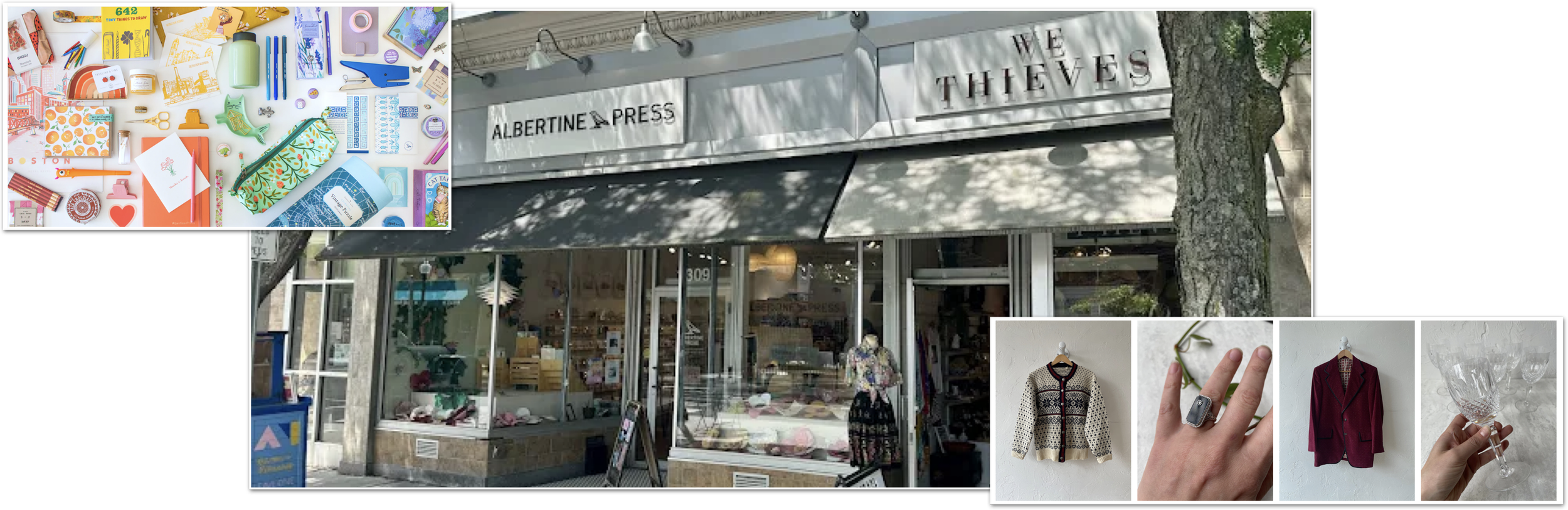
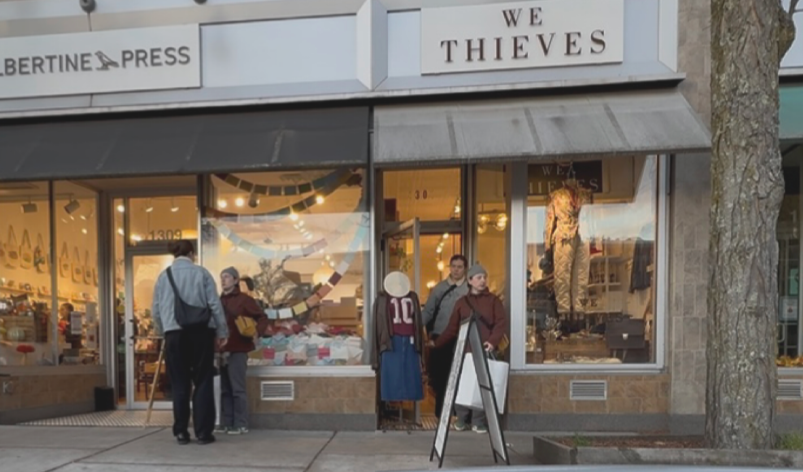
Store proximity: adjacent stores often benefited from one another as pedestrians engaged with both spaces or comfortably lingered between them, producing a micro-cluster of activity that neither store could generate independently
Why this matters
These findings show that staying behavior is not random, but shaped by the interaction between pedestrian intent and retail conditions such as store mix, adjacency, and storefront design. Clusters of small businesses can amplify lingering through shared visibility and comfort, creating localized pockets of street-level vitality. This shifts the focus from measuring foot traffic alone to understanding what actually encourages people to stop, linger, and connect.
Together, the findings suggest that staying behavior emerges from the interaction between individual intent and the surrounding retail environment, with retail clusters acting as anchors of micro-scale vitality that encourage pedestrians to slow down, engage, and participate in street-level social life.
Spatial and Environmental Conditions
Environmental features also influenced whether pedestrians chose to stop or linger:
Street amenities such as seating, bike lanes, and trash bins supported ease of use
Storefront transparency made it easier for pedestrians to assess whether they wanted to enter
Weather and microclimate, including sunlight and wind exposure, affected how long people stayed outdoors
Spatial enclosure and materials influenced comfort, particularly in seating areas
These conditions shaped how welcoming or restrictive a street felt during observation periods.
How sunlight, comfort, and storefront visibility shape staying behavior?
Welcoming amenities and microclimate-sensitive spatial comfort are foundational environmental supports that enable pedestrians to slow down, linger, and participate in neighborhood life. These spatial qualities reduce friction, enhance comfort, and create conditions in which staying behavior becomes natural rather than effortful.
Welcoming Street Infrastructure: Micro-spatial infrastructures: amenities that respond to pedestrians’ everyday needs supports longer stay and comfortable movement through the neighborhood (e.g., trash bin, bike lane, sidewalk)
Storefront Transparency & Visual Engagement: Storefronts that effectively pique pedestrian interest will encourage store visits and convert window shoppers into browsers to foster streets where pedestrians would pause and engage
Weather and microclimate: Sunlight, mild wind conditions, and warm air temperatures create welcoming outdoor environments that support longer stationary activity
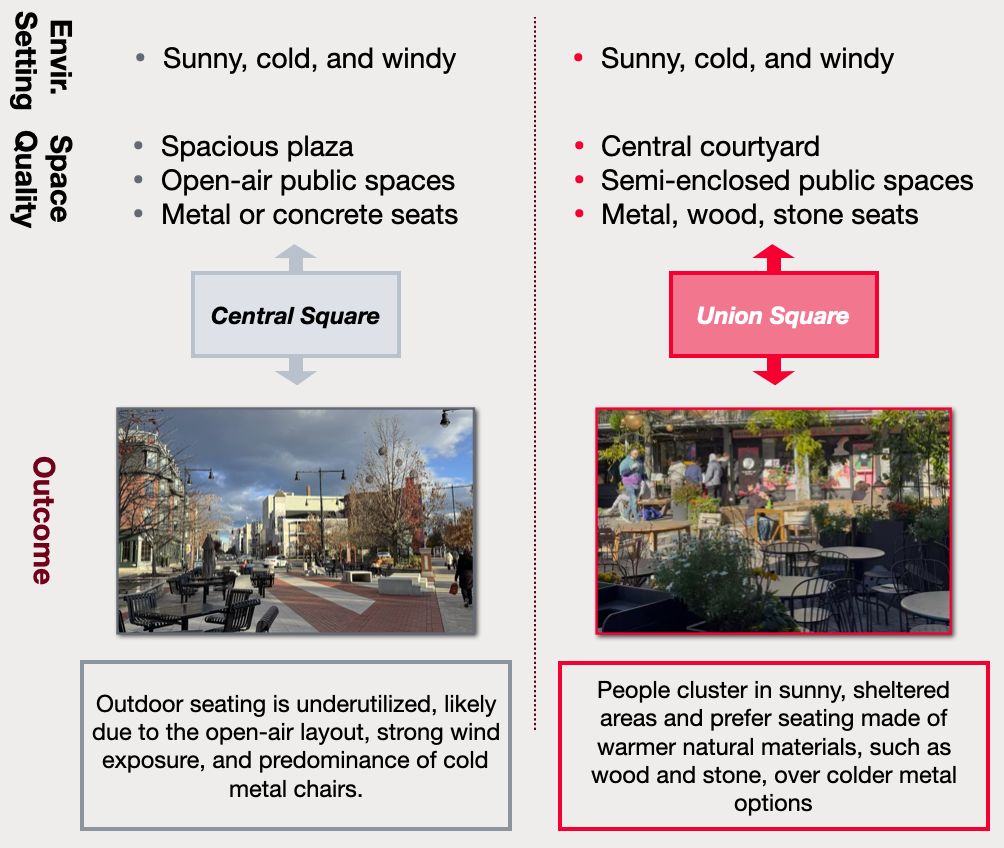
Space Quality: Warm, natural materials like wood make seating more inviting, whereas metal feels cold and discourages lingering. Semi-enclosed spaces further support casual conversation, unlike open-air areas where seating tends to be more spread out
Welcoming Amenity
Spatial Comfort
Urban Experience Implications:
Neighborhoods that offer accommodating amenities, visually engaging storefronts, and semi-enclosed public spaces with weather protection are far more inviting and supportive of pedestrian staying behavior than open, unprotected streets with sparse seating.
How do retail stores and their surrounding environmental conditions jointly enable pedestrian “staying” behavior and contribute to neighborhood vitality?
Neighborhoods with user-friendly amenities and comfortable microclimate conditions create the environmental enablers that encourage pedestrians to stay longer on the street.
Neighborhood Comparisons
The three study areas showed distinct patterns of staying behavior.
Inman Square
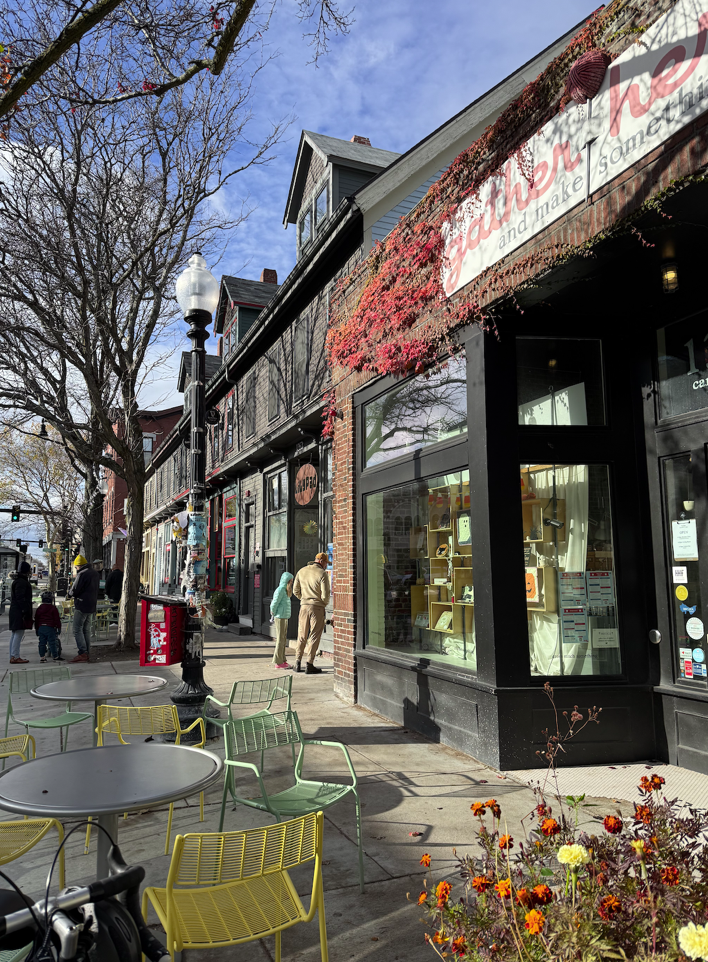
Inman Square features clusters of independent businesses and relatively consistent street-level engagement. Pedestrians often paused to browse storefronts, and amenities supported walking and short stays.
Observation
Retail clustering and manageable street scale appeared to support exploration and lingering.
Central Square
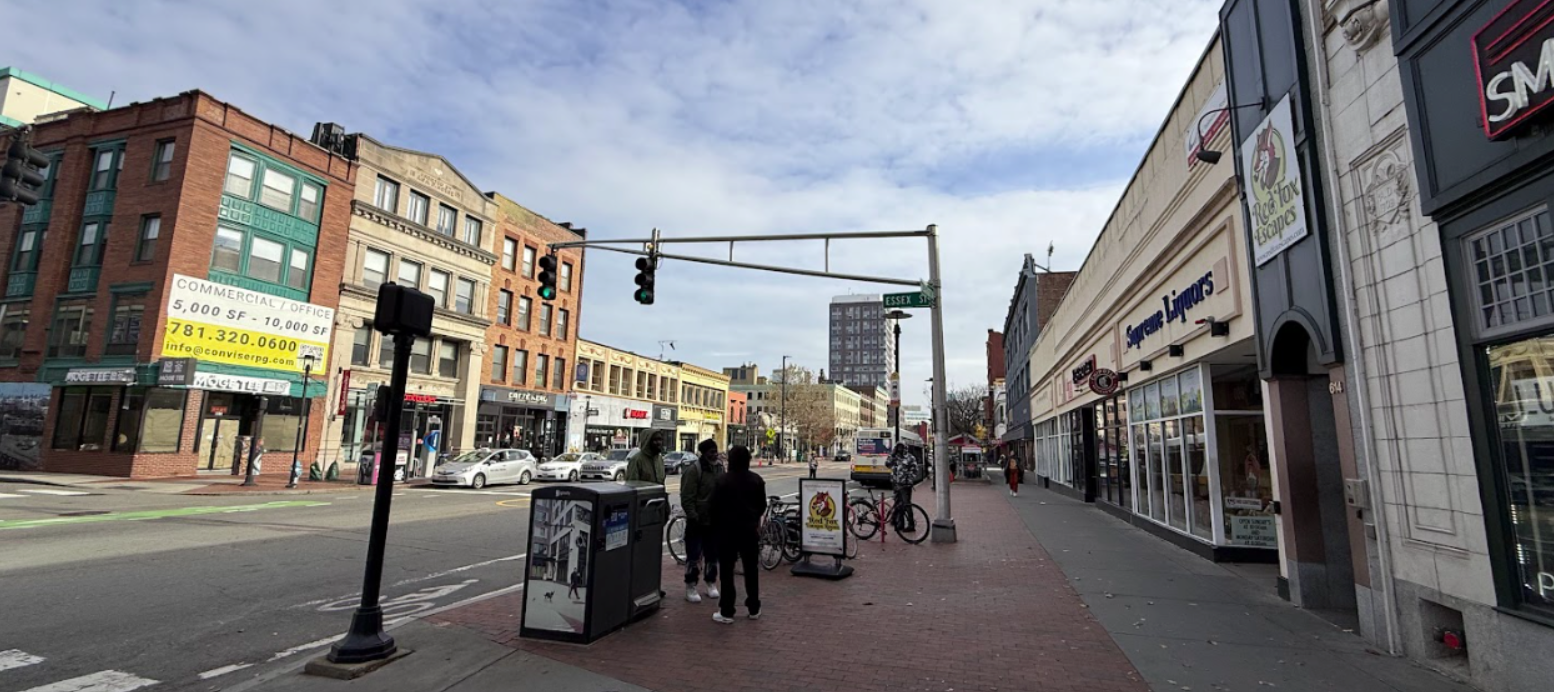
Central Square functions as a major transit and commercial corridor. While pedestrian movement was high, staying behavior was uneven. Exposed seating, wind, and storefront turnover appeared to limit longer outdoor stays.
Observation
High pedestrian volume did not consistently correspond with longer stays.
Union Square (Bow Market)
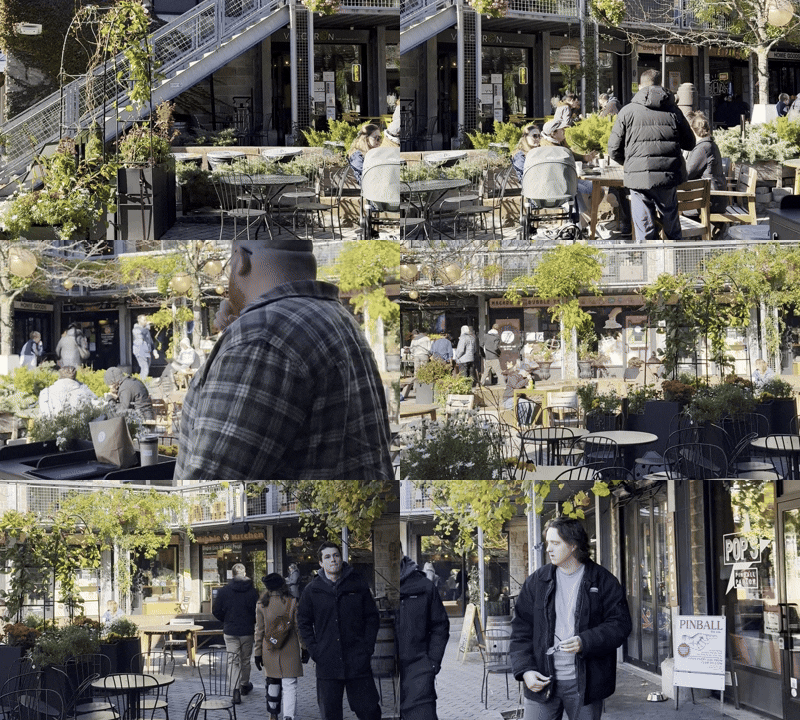
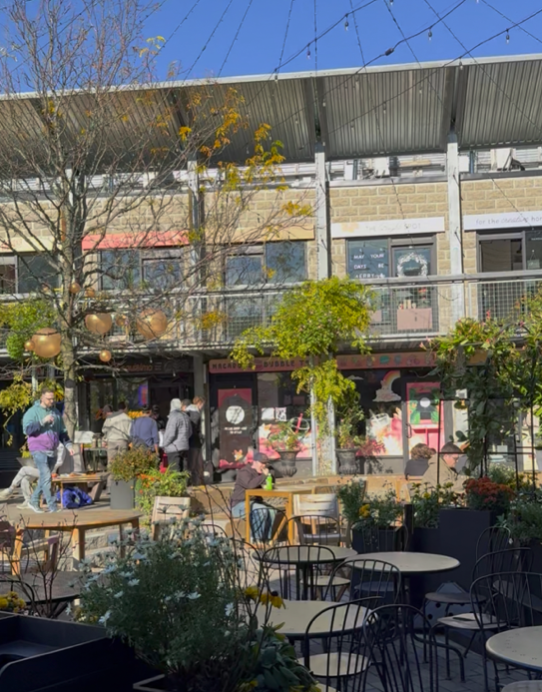
Bow Market’s semi-enclosed courtyard and concentration of small businesses supported frequent lingering. Pedestrians often moved between stores and used shared seating areas.
Observation
Spatial enclosure and close proximity of stores supported longer stays and informal interaction.
Community and Business Perspectives
Survey and interview responses supported observational findings. Many pedestrians reported staying longer in places where streets felt comfortable, lively, and easy to navigate. Several noted that familiarity with stores or repeated visits increased their willingness to spend time in the area.
Business owners emphasized the importance of visibility, storefront presentation, and personal interaction in attracting pedestrians. These perspectives helped contextualize observed behavior patterns.
“I’m here just to rest and enjoy the sun… I’ll stay until the sun goes down and when it’s too cold.”
“Having more outdoor areas, such as small parks with sitting areas, and vendors would make me feel more belonged.”
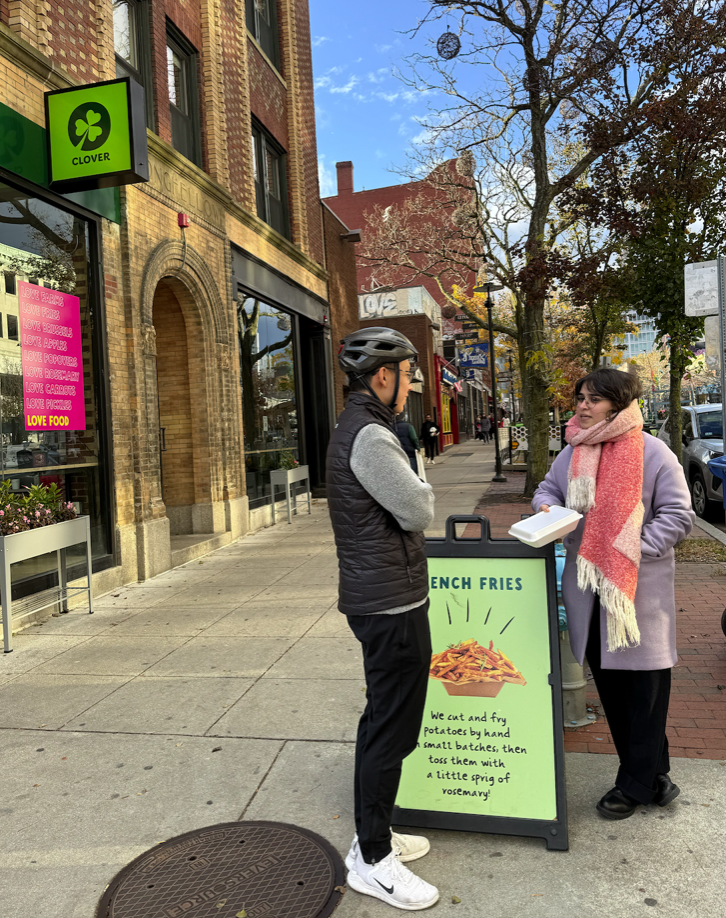
“We sponsor local climbing events very often and many people know us from there”
“We curate our Porter store differently; this is intentional because we are aware of the different clientele.”
Key Takeaways
Direction for Further Work
The observations from Local Loop identify behavioral and environmental factors that could inform future neighborhood-scale analysis. Possible next steps include:
Organizing observed behaviors into consistent behavioral categories
Translating environmental conditions into comparable variables
Exploring how different retail configurations relate to staying behavior patterns
These steps would support more structured analysis of neighborhood retail environments.
Old versions for reference
How do retail stores and their surrounding environmental conditions jointly enable pedestrian “staying” behavior and contribute to neighborhood vitality?
Why “staying” activity is a deeper signal of vitality than movement of street users?
Hypothesis:
Pedestrian engagement, small business clustering, spatial comfort, and environmental cues significantly increase stationary human behavior, such as pausing, standing, lingering, waiting, browsing, interacting
“Staying” Activity as Indicator for Urban Vitality
Neighborhood vitality is often expressed through the visible movement of street users: pedestrians passing storefronts, cyclists gliding along bike lanes, and vehicles flowing through intersections.
But it is the more stationary “staying” activities—pausing, lingering, browsing, talking, and gathering—that reveal deeper qualities of a place. These behaviors make belonging visible in public space, signaling comfort, safety, and emotional ease; they show that people feel welcome enough to slow down, occupy space, and engage with their surroundings.
Small local businesses play a central role in enabling this. As informal “third spaces,” they invite people to stay, interact, and form social ties, serving as anchors for spontaneous social life.
Staying behavior captures the lived, relational dimension of urban vitality — something movement counts alone can never measure.
How Pedestrians Use the Street?
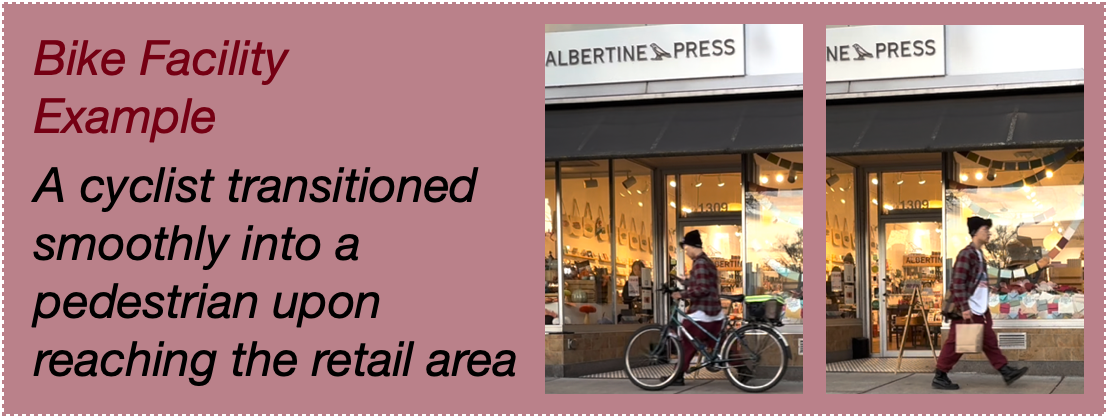
Visitors, Browsers, and Window Shoppers
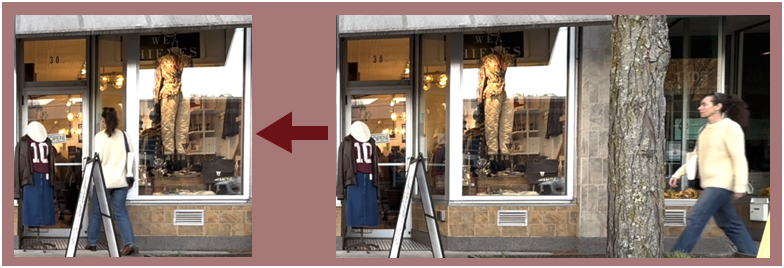
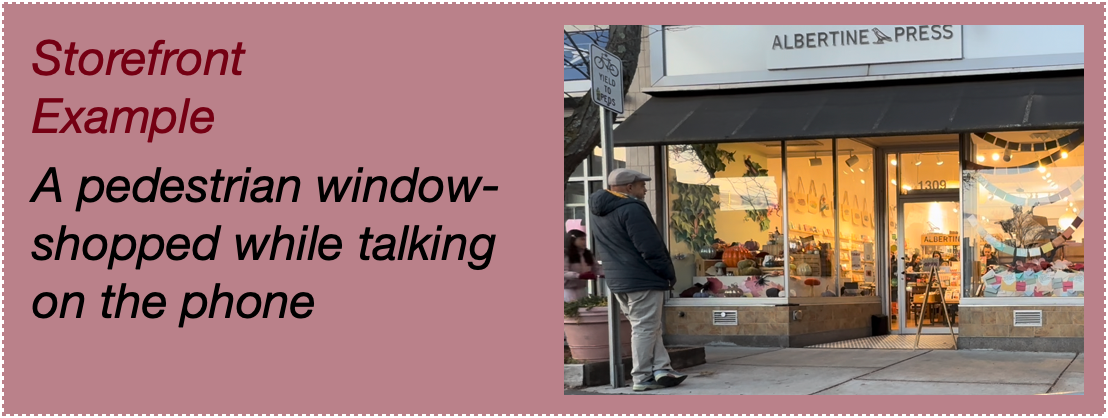
Initial street-level observations revealed four distinct pedestrian types, visitors, browsers, window-shoppers, and passersby, each expressing different levels of engagement with storefront environment.
Visitors arrive with intent: they plan their destination in advance and enter the store with little hesitation.
Browsers make spontaneous decisions to enter, typically prompted by storefront displays or visual cues.
Window-shoppers pause to examine the displays but ultimately do not go inside.
Passersby move with clear purpose, show no signs of engagement, and are likely using the street primarily for commuting or time-bound travel.
These categories reveal gradients of attention and engagement, helping interpret the different forms of “staying” behavior along the street. Browsers, in particular, represent the key conversion point where passive interest (window-shopping) transitions into active participation (visiting).
Understanding these distinctions is essential for analyzing how pedestrian behavior contributes to street-level “static” activity, how stores attract and retain foot traffic, and how storefront business collectively shape neighborhood vitality.
Stationary Behavior Observation Insights
What staying, pausing, and lingering reveal about people and place?
Observations revealed that “staying” behavior is shaped not only by store characteristics but also by subtle psychological and social drivers.
Pedestrian type: Intentional visitors stayed longer (~+40%) than spontaneous browsers, showing that purpose-driven trips meaningfully increase stationary activity.
Group dynamics: Groups lingered longer inside stores (~+240%), while window-shopping groups stayed less time outside (~–30%), suggesting that collective decision-making accelerates movement unless there is strong motivation to pause.
Retailer category: Shoppers spent more time in Albertine Press, which offers a broader product range and serves a wider demographic, highlighting how store scale, diversity, and identity shape engagement
Business clusters: The synergy between Albertine Press and We Thieves was unexpectedly strong: pedestrians frequently browsed both stores, and customers from one store comfortably lingered near the other. Retail adjacency produced a micro-cluster of activity that neither store could generate alone.
Why this matters:
These findings show that “staying” behavior is not random—it emerges from a mix of behavioral drivers (intent, curiosity, group dynamics) and supply-side factors (retail mix, product diversity, storefront design). Most importantly, clusters of small businesses can amplify staying behavior through mutually reinforcing visibility and comfort, creating localized pockets of vibrancy. This understanding allows us to move beyond simply measuring foot traffic to analyzing what actually makes people stop, linger, and connect—the key ingredients of street-level vitality.
How do retail stores and their surrounding environmental conditions jointly enable pedestrian “staying” behavior and contribute to neighborhood vitality?
Together, these findings show how retail stores act as anchors of micro-scale vitality, enabling pedestrians to slow down, engage with storefronts, and participate in the social life of the street.
Spatial & Environmental Drivers of Staying Behavior
How sunlight, comfort, and storefront visibility shape staying behavior?
Welcoming amenities and microclimate-sensitive spatial comfort are foundational environmental supports that enable pedestrians to slow down, linger, and participate in neighborhood life. These spatial qualities reduce friction, enhance comfort, and create conditions in which staying behavior becomes natural rather than effortful.
Welcoming Street Infrastructure: Micro-spatial infrastructures: amenities that respond to pedestrians’ everyday needs supports longer stay and comfortable movement through the neighborhood (e.g., trash bin, bike lane, sidewalk)
Storefront Transparency & Visual Engagement: Storefronts that effectively pique pedestrian interest will encourage store visits and convert window shoppers into browsers to foster streets where pedestrians would pause and engage
Weather and microclimate: Sunlight, mild wind conditions, and warm air temperatures create welcoming outdoor environments that support longer stationary activity
Space Quality: Warm, natural materials like wood make seating more inviting, whereas metal feels cold and discourages lingering. Semi-enclosed spaces further support casual conversation, unlike open-air areas where seating tends to be more spread out
Welcoming Amenity
Spatial Comfort
Urban Experience Implications:
Neighborhoods that offer accommodating amenities, visually engaging storefronts, and semi-enclosed public spaces with weather protection are far more inviting and supportive of pedestrian staying behavior than open, unprotected streets with sparse seating.
How do retail stores and their surrounding environmental conditions jointly enable pedestrian “staying” behavior and contribute to neighborhood vitality?
Neighborhoods with user-friendly amenities and comfortable microclimate conditions create the environmental enablers that encourage pedestrians to stay longer on the street.
Neighborhood Case Studies: Three Neighborhoods, Three Vitality Patterns
Inman Square · Central Square · Union Square (Bow Market)
Inman Square
Independent business clustering, welcoming amenities, and human-scale storefronts
Inman Square offers a family-friendly, walkable environment where pedestrians frequently engage with storefronts. A diverse cluster of independent businesses along Cambridge Street provides curated, visually appealing displays that invite browsing and lingering. Accommodating street amenities, such as clearly designated bike lanes and accessible storefronts with automatic doors, support safe and equitable movement for users of all ages and mobility needs. These spatial and environmental qualities work together to create an inviting streetscape where pedestrians feel comfortable exploring, pausing, and staying longer.
Core Insight: Independent business clustering combined with welcoming spatial qualities creates a walkable, family-oriented environment that naturally encourages exploration and staying behavior.
Central Square
Commercial corridor with climate-challenged public spaces and uneven pedestrian engagement
Central Square operates as both a major transit gateway and a commercial corridor where chain stores and long-standing local businesses coexist. Wide, accessible sidewalks and plentiful public seating support diverse street users, but many seating areas remain underutilized when placed in exposed, windy locations or constructed from colder materials that discourage comfort. Despite steady foot traffic, the area faces persistent storefront vacancies and turnover, interrupting retail continuity and diminishing opportunities for street-level engagement. The result is a dynamic yet uneven environment: active and loud, with strong pedestrian flow but inconsistent spatial comfort and limited staying behavior.
Core Insight: A high-traffic transit and commercial hub with lively street activity but inconsistent spatial comfort that disrupts sustained pedestrian engagement
Union Square (Bow Market)
Sunlight, warm materials, and shared spatial enclosure as social anchors
Union Square’s former concrete-block storage facility, Bow Market, has been transformed into a dense cluster of independent businesses organized around a shared courtyard that consistently attracts high pedestrian activity. The semi-enclosed courtyard is surrounded by storefronts and furnished with abundant seating made from warm, natural materials, creating an intimate, comfortable environment that encourages lingering. This spatial arrangement brings visitors into close proximity, fostering spontaneous interactions, fluid movement between shops, and extended periods of staying. As a result, Bow Market functions as a vibrant “third place,” strengthening social life and contributing significantly to the broader vitality of Union Square.
Core Insight: A revitalized local business hub whose shared courtyard and warm spatial qualities generate strong staying behavior, social interaction, and movement between neighboring shops.
Neighborhood Comparison
Community & Business Voices
What residents and small business owners reveal about staying and belonging?
Community voices from surveys and interviews reinforce the observational findings and highlight how retail stores and environmental cues shape staying behavior. Residents report lingering longer in places where there is more to experience, where streets feel lively and safe, and where microclimate conditions and amenities create comfort. Many expressed that they would spend more time in Central Square if there were more public art, a broader and more diverse retail mix, and public spaces better designed for sunlight, warmth, and shelter. A sense of belonging also emerges through routine interactions: some people noted that becoming frequent customers deepens their attachment to place.
Business owners echo these themes, emphasizing that visibility, curated storefronts, and personalized interactions are essential for attracting foot traffic and sustaining engagement. Unlike chain stores that rely on mass marketing, small businesses depend on their physical presence and in-store experience to capture attention, encourage browsing, and build long-term customer relationships. This alignment between resident and retailer perspectives underscores the role of local businesses and spatial quality in generating comfort, familiarity, and the conditions that encourage people to pause, explore, and stay.
“I’m here just to rest and enjoy the sun… I’ll stay until the sun goes down and when it’s too cold.”
“Having more outdoor areas, such as small parks with sitting areas, and vendors would make me feel more belonged.”
“We sponsor local climbing events very often and many people know us from there”
“We curate our Porter store differently; this is intentional because we are aware of the different clientele.”
Key Insights
Four core patterns that define neighborhood vitality
Retail and street-level amenities encourage stationary behavior by offering multiple points of engagement for pedestrians. Storefront displays, sidewalk signage, street decorations, and even small details like posters on utility poles spark curiosity and invite people to pause. These micro-moments of attention accumulate into longer periods of lingering within a neighborhood. Ultimately, retail-driven touch points play a foundational role in fostering a dynamic and interactive public realm.
Clusters of retail businesses strengthen walkability and make neighborhood exploration more compelling. When stores are concentrated, they form micro-districts of vibrancy that anchor foot traffic and support spontaneous movement along the street. These zones naturally become hubs where social interaction and community connections take shape. They also enhance perceived safety by increasing “eyes on the street,” reinforcing the street’s overall sense of comfort.
Street-level amenities reduce friction in the pedestrian experience and make neighborhoods easier and more enjoyable to navigate. Even small elements, such as accessible trash bins, contribute to comfort and help sustain longer visits across multiple businesses. Retail stores also function as amenities when they offer visual permeability and warm lighting that communicate openness and safety. Together, these features create a street environment where pausing, browsing, and entering stores feel natural rather than effortful.
Spatial comfort strongly influences whether pedestrians choose to remain in public spaces. Seating that is exposed to wind or harsh microclimate conditions is often avoided, even when technically available. Semi-enclosed courtyards and areas with warm, natural seating materials counter these challenges by offering intimacy, shelter, and tactile comfort. These configurations support organic social interaction and encourage people to stay longer within a neighborhood.
Advancing Retail Placemaking: Project Direction and Action Plan
How can neighborhood business ecosystem be designed and strengthened to draw pedestrians into stores, amplify staying behavior, and cultivate consumer preference for in-person experiences?
Learning
Stationary behavior emerges from the interplay of behavioral, spatial, and environmental enablers. Neighborhoods that support longer stays typically offer continuous street-level points of engagement, businesses located within walkable distances that provide more to explore, amenities that ensure convenience and safety, and public spaces that offer protection from undesirable environmental conditions.
Across these factors, business clusters stand out as a uniquely generative force. Their presence can produce virtuous effects on the other variables: clusters extend the range of experiences available to pedestrians, strengthen the continuity of active street edges, and motivate collective action among business owners to enhance storefront visibility, improve public-realm amenities, and shape a more comfortable and engaging street environment.
Refined Approach
Local Loop will explore how the virtuous cycle of staying behavior can be strengthened through neighborhood business clusters. Building on insights from pedestrian engagement, spatial comfort, and retail-environment interactions, the refined approach focuses on understanding how clusters extend the duration, continuity, and intensity of street-level activity. The project will examine how coordinated storefront design, shared amenities, and complementary retail offerings collectively shape the micro-scale conditions that encourage pedestrians to pause, explore, and move fluidly between businesses.
Contribution
This work contributes a framework that disentangles retail placemaking into three mutually reinforcing mechanisms:
Supercharging the offline experience
Understanding how intentional visits and sensory-rich, in-person interactions draw pedestrians into storefronts and prolong their stay.Strengthening business clustering
Demonstrating how adjacency, diversity, and coordinated storefront presence reinforce lingering patterns, produce micro-clusters of vitality, and stimulate positive spillover effects between neighboring businesses.Reframing consumer preference for in-real-life experiences in the digital age
Showing how physical retail streetscapes, when designed intentionally, can offer social, sensory, and emotional value that digital platforms cannot replicate.
Together, these mechanisms articulate how retail environments can operate as active agents in shaping neighborhood vitality rather than passive backdrops.
Next Steps
The next phase of Local Loop will translate these insights into a modeling and intervention framework that support simulation of retail placemaking and consumer decision-making:
Develop a neighborhood-scale cluster typology that classifies business configurations by spatial adjacency, retail diversity, and their potential to generate engagement.
Prototype agent-based decision rules that reflect how pedestrians respond to storefront cues, cluster density, microclimate comfort, and street-level amenities.
Simulate targeted interventions such as curated storefront, shared amenities, and coordinated programming to evaluate how business clusters can amplify staying behavior under varying urban conditions.
Identify leverage points where design or operational adjustments can reinforce the virtuous cycle of staying and strengthen neighborhood vitality.
These steps position the project to contribute a computational-driven and behaviorally grounded understanding of how business clusters operate as engines of urban social life.
Personal Reflection
What observing real neighborhoods taught me
Growing up around small family businesses taught me that local commerce serves as both economic and social infrastructure. Living in metropolises far more diverse than my hometown made me realize that retail establishments are places where cultures meet, communities form, safer streets are maintained, and the vibrancy of urban life becomes visible.
Local Loop is a project that aims to deepen understanding of how independent offline retail businesses can thrive in an era of digitalization and retail decline, so that vibrant streetscapes and a strong sense of neighborhood belonging can be preserved.
With my training in strategy consulting, I initially approached this project from a supply-and-demand perspective, assuming that the key to building and preserving strong local business networks was simply connecting stores with consumers. I quickly realized that this framing overlooked the richness of street-level human interaction, and I began to question whether a traditional economic lens could meaningfully explain what makes cities and places thrive. Through direct observation, I learned to think more systematically and discovered the value of translating behavioral insights into variables that can support deeper analysis and modeling.