Modeling Neighborhood-Scale Retail Dynamics
This project simulates how anchor strength and small-business vitality influence pedestrian movement and lingering behavior in Central Square, Cambridge. The workflow integrates network science and agent-based modeling to estimate how people might move and pause in response to changes in neighborhood retail ecosystems.
Methodology
1. Data Pipeline
Central Square BID business dataset
OpenStreetMap street network
Scenario modifications
2. Scenario Construction
Baseline Case
Represent case as of December 2025
Designate anchors ( range from 0.4 to 1.0)
Scenario 1 — Public Space Intervention
Design intention: enhance Jill Brown-Rhone Park with amenities that meaningfully draw people
seating, greenery, programming, lighting, etc.
Model implementation: increased anchor weight for the park
Scenario 2 — Small Business Boost
Behavioral assumption: small, independent businesses become more attractive relative to chains
reflecting trends such as “shop local,” curated retail experiences, and human-scale service
Model implementation: increased anchor weight for non-chain stores
System Design
Agent-Based Modeling Rules
Each agent represents a simulated pedestrian.
Initialization
300 agents seeded at random network nodes
120 movement steps each
Movement Rule
At each step, an agent chooses among neighbors using:
Where:
A(v) = node attractiveness from retail + anchor effects
d(u,v) = edge distance
β = sensitivity to attractiveness
c = distance penalty
Lingering Rule
At each node:
Output Metrics
Movement Flow: how often edges are traversed
Lingering Heat: accumulated dwell time at nodes
Anchor Influence Map: visualized anchor weights
Maps
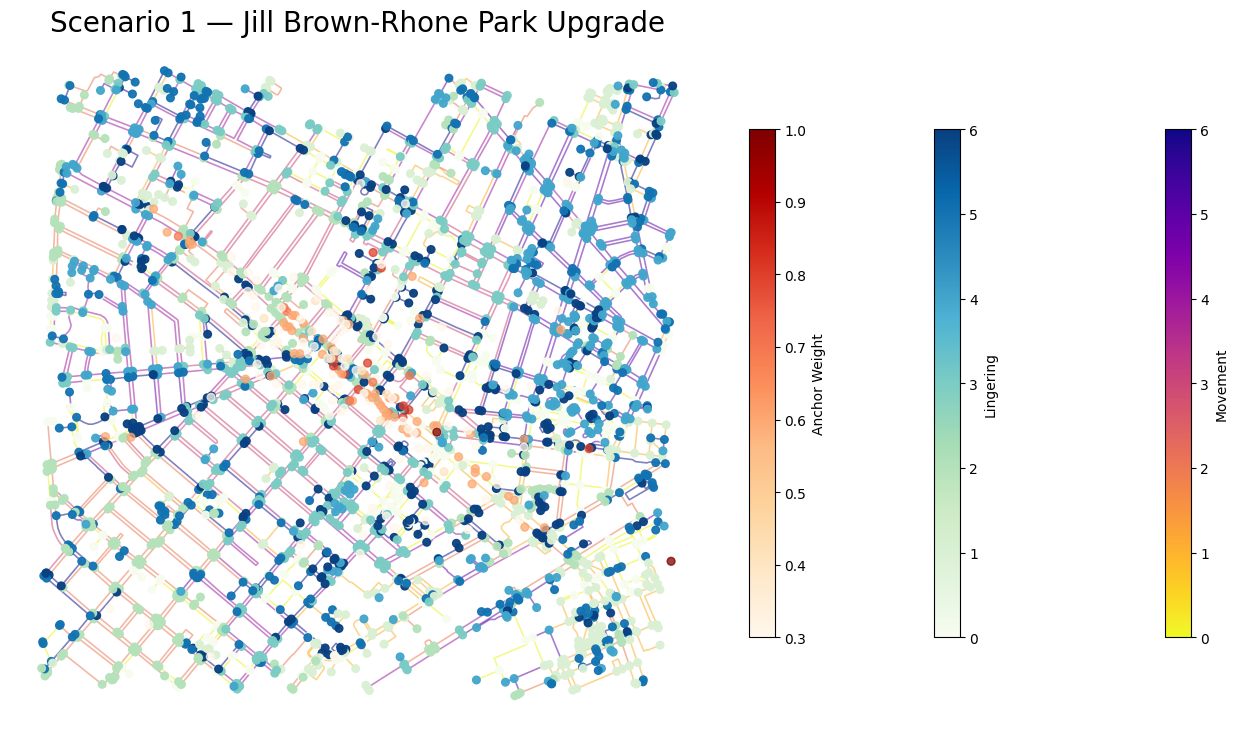
Significant increase in lingering near the park:
Agents now treat it as a destination rather than a pass-through.Adjacent edges show higher movement flow, as agents divert toward the upgraded node.
The park becomes a third anchor balancing MIT/Harvard influence.
Slight reduction of lingering at nearby mid-tier anchors due to competition for attention.
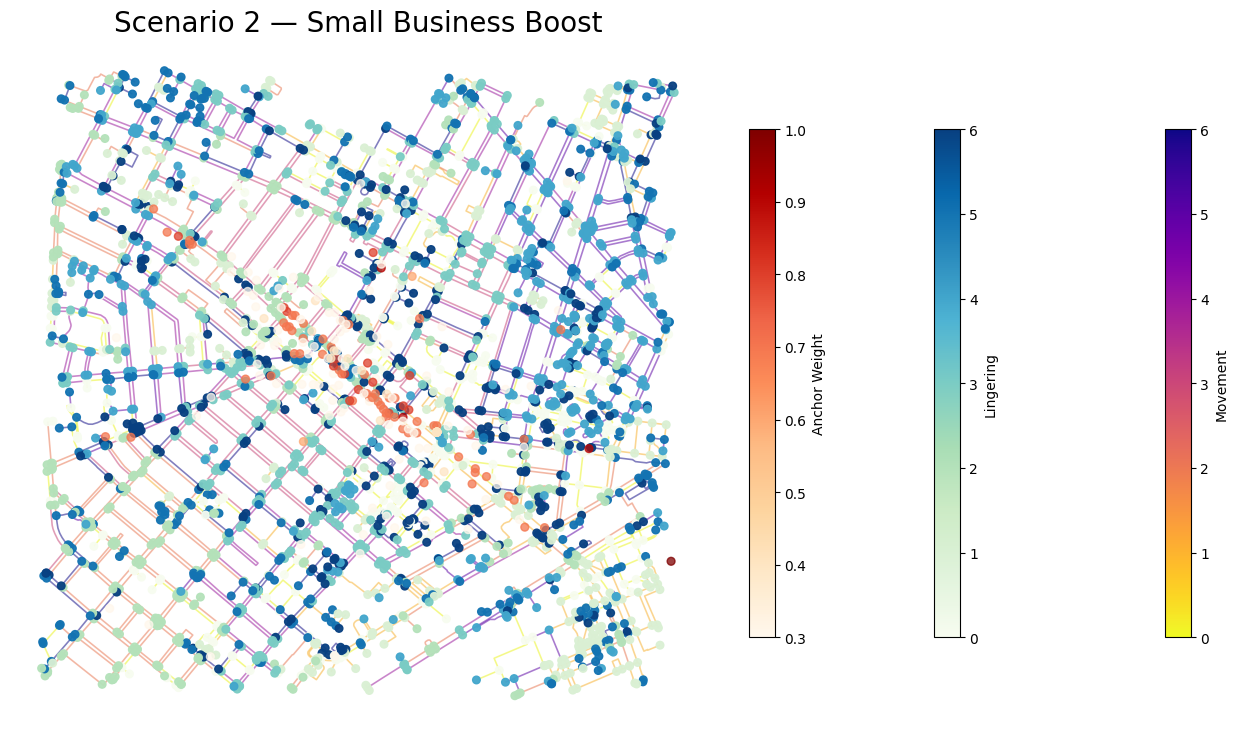
More distributed lingering—a network of micro-anchors emerges.
Flow becomes less centralized, spreading further into smaller side streets.
Stronger reinforcement of “local loop” behavior:
Agents stay within a walkable cluster of interesting small businesses.Chain stores do not receive boosts → local retail becomes more competitive.
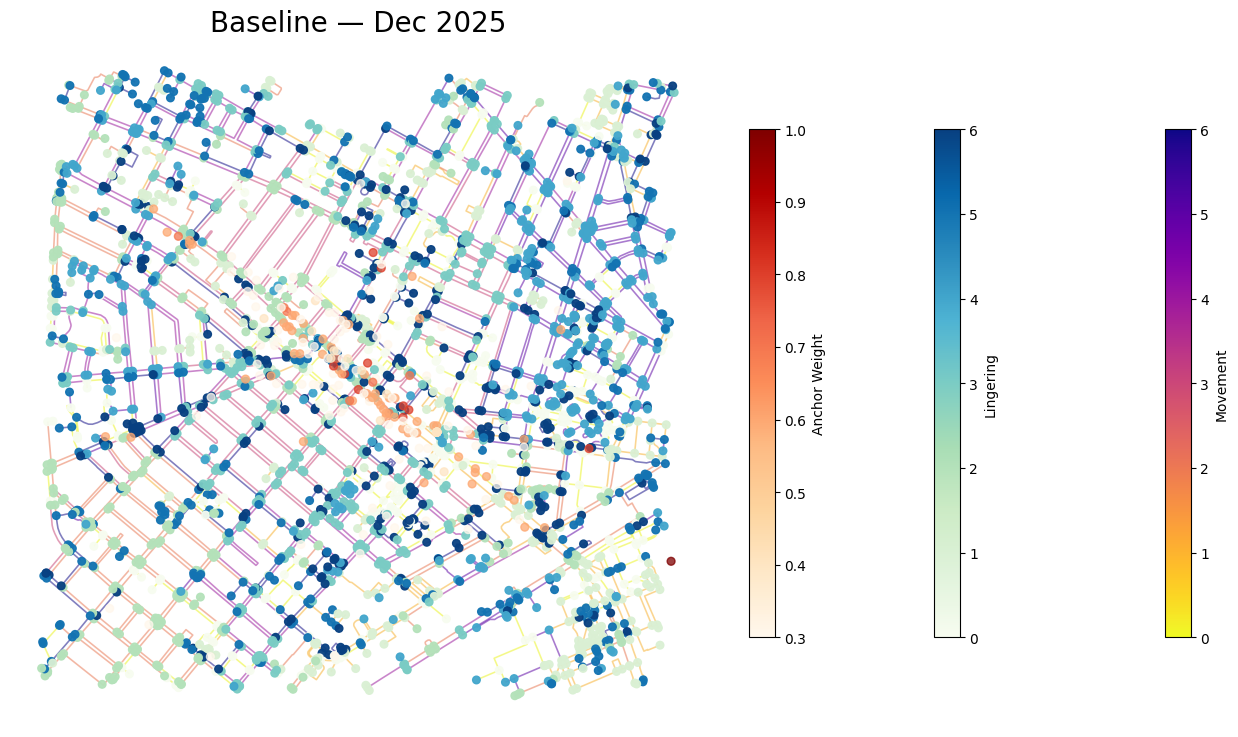
Strongest anchors: MIT and Harvard → pull agents north and south.
Moderate anchors (restaurants, cafés) create a central ribbon of activity along Mass Ave.
Lingering clusters appear around food + cultural venues.